
How to Calculate Compound Interest in 5 Simple Steps (With Real Examples)
Most of us learned the interest formula in school, then completely forgot it. That’s fine — because understanding why compound interest behaves the way it does is more useful than memorising a formula. Once you get it, you start seeing it everywhere: your FD, your home loan EMI, your SIP returns, your credit card balance.
This post covers the whole thing from scratch. No jargon, no shortcuts, just clear step-by-step logic.
Before You Calculate: Understanding What You’re Working With
Compound interest is not the same as simple interest, and the difference becomes dramatic over time. Here’s a quick way to think about it:
- Simple interest is like renting your money to someone. Every year you get the same fixed rent, nothing more.
- Compound interest is like planting a tree that grows seeds — and each seed grows its own tree. The interest you earn in year one starts generating its own interest in year two.
That second model is what makes long-term investors wealthy and long-term debtors broke. Same mechanism, opposite outcomes.
The Compound Interest Formula, Explained Simply
That looks intimidating at first. Let’s break it apart so it makes sense intuitively:
- (r/n) — This gives you the interest rate per compounding period. If your annual rate is 12% and it compounds monthly, each month you earn 1% (12 ÷ 12).
- (1 + r/n) — Adding 1 represents keeping your original amount plus earning the period’s interest. Think of it as a growth multiplier.
- Raising it to the power (nt) — This applies that multiplier repeatedly. If you compound monthly for 5 years, you apply it 60 times (12 × 5).
- Multiplying by P — Scales the result back to your actual investment amount.
To get the interest earned alone, just subtract your principal at the end: CI = A − P
How to Calculate Compound Interest: Step-by-Step
- 1
Write down your principal (P)
This is your starting amount — the money you’re investing or the loan amount. Example: ₹2,00,000. Do not confuse this with the total you expect to have at the end.
- 2
Convert the annual interest rate to a decimal (r)
Divide the percentage by 100. If your bank offers 9% per year, r = 9 ÷ 100 = 0.09. Never plug in the percentage directly — it will give you a wildly wrong answer.
- 3
Decide your compounding frequency (n)
How many times per year does the bank add interest to your account? Common values: yearly (n=1), quarterly (n=4), monthly (n=12), daily (n=365). Most Indian FDs compound quarterly. Most savings accounts compound monthly.
- 4
Set your time period in years (t)
This must be in years. If your tenure is 18 months, convert it: 18 ÷ 12 = 1.5 years. Make sure t and n are consistent — both should be based on the same year unit.
- 5
Apply the formula and calculate
Plug everything into A = P(1 + r/n)nt. Use a scientific calculator or our free tool below. Start inside the brackets, compute the exponent, then multiply by P. Subtract P at the end to isolate the interest earned.
Worked Example: FD Investment
Let’s solve a real-world example completely:
| Principal (P) | ₹2,00,000 |
| Annual Interest Rate (r) | 9% → 0.09 |
| Compounding Frequency (n) | Quarterly (4 times/year) |
| Time Period (t) | 5 years |
Step 1: r/n = 0.09 ÷ 4 = 0.0225 per quarter
Step 2: (1 + 0.0225) = 1.0225
Step 3: nt = 4 × 5 = 20 compounding periods
Step 4: 1.022520 = 1.5605 (approx.)
Step 5: A = 2,00,000 × 1.5605 = ₹3,12,100 (approx.)
Does Compounding Frequency Actually Matter?
Yes — but maybe less than you’d expect for moderate tenures. Here’s how different frequencies compare on the same ₹1,00,000 at 10% for 10 years:
| Compounding | n (per year) | Final Amount | Interest Earned |
|---|---|---|---|
| Yearly | 1 | ₹2,59,374 | ₹1,59,374 |
| Quarterly | 4 | ₹2,68,506 | ₹1,68,506 |
| Monthly | 12 | ₹2,70,704 | ₹1,70,704 |
| Daily | 365 | ₹2,71,791 | ₹1,71,791 |
Daily compounding earns about ₹12,417 more than yearly over 10 years on the same ₹1 lakh. That gap widens significantly with larger principals and longer tenures.
3 Common Mistakes When Calculating Compound Interest
Mistake 1: Using the rate as a percentage instead of a decimal
If you enter r = 8 instead of r = 0.08, you’ll get a number that is completely wrong. Always divide your rate by 100 before plugging it in. This is the single most common error.
Mistake 2: Mixing up the time unit
If n is monthly (12) but t is in months instead of years, your answer will be off. Keep t strictly in years. An 18-month deposit = t of 1.5, not 18.
Mistake 3: Confusing total amount (A) with interest earned (CI)
The formula gives you A — the total amount including your principal. To find out how much you actually earned, subtract your starting principal: CI = A − P. Banks and financial calculators often report both figures separately.
When Manual Calculation Gets Complicated
Manual calculation with the formula works perfectly for straightforward scenarios. But in real life, you often need to:
- Compare multiple compounding frequencies side by side
- See a year-by-year breakdown of how your balance grows
- Quickly try different “what if” scenarios (what if the rate was 10% instead of 8%?)
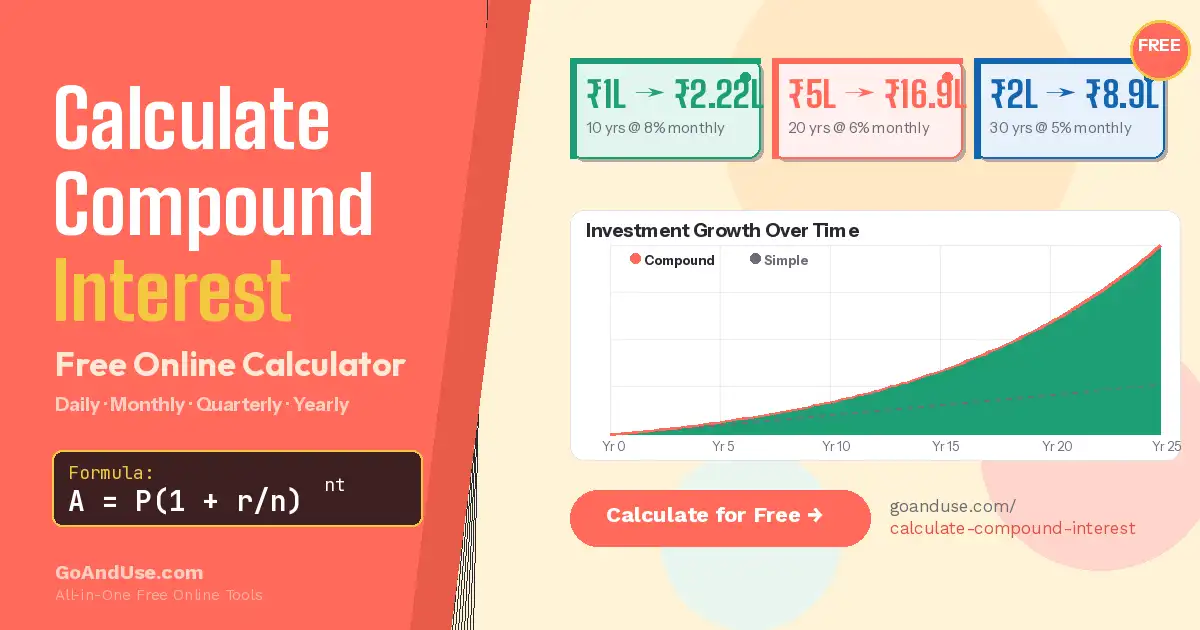
- Visualise growth on a chart to understand the exponential curve
That’s exactly what a good calculator handles in seconds — without the risk of arithmetic errors.
Try It Now — Free Compound Interest Calculator
Instant results. Year-by-year table. Growth chart. Compare compound vs simple interest side by side. No sign-up needed.
📈 Calculate Compound Interest Free → Works on mobile, tablet and desktop. 100% free, forever.Quick Answers to Common Questions
Use A = P(1 + r/n)3n. Set t = 3 in the formula. If you’re compounding monthly (n=12), the exponent becomes 36. Our calculator handles this automatically — just set years to 3.
At 8% compounded monthly: A = 1,00,000 × (1 + 0.08/12)60 ≈ ₹1,48,985. You earn about ₹48,985 in interest over 5 years — nearly half your original investment.
Daily compounding always gives slightly more than monthly, because interest is added 365 times per year instead of 12. The difference is small on short tenures but grows with time and principal size.
Yes — the same compound interest formula applies to loans. Your outstanding loan balance grows if you don’t make payments, using the same A = P(1 + r/n)nt logic. Loan EMIs are structured to offset this growth over the repayment period.
Wrapping Up
Calculating compound interest manually is a five-step process once you understand the formula. The key is getting your inputs right — especially converting the rate to a decimal and keeping your time period in years. Everything else is just arithmetic.
But honestly, the bigger takeaway here is not the formula. It’s the behaviour: compound interest rewards patience. A ₹50,000 investment sitting at 10% for 30 years becomes over ₹8.7 lakh — that’s not a trick, it’s just mathematics working quietly over time.
Use our calculator to run your own numbers and see what your money could look like 10, 20, or 30 years from now.